Book Categories:

Heat Tape on PEX Pipe: Safe Installation Rules, Temperature Limits, and Code Compliance
Installing heat tape on PEX pipe is completely safe when contractors use certified self-regulating heating cables. However, cross-linked polyethylene conducts thermal energy slowly, which creates localized thermal hotspots if heating cables operate unchecked. Contractors must apply continuous aluminum foil tape beneath the heating cable to distribute thermal energy across plastic piping. Furthermore, commercial installers must avoid constant-wattage heating tapes to protect the structural integrity of the polymer substrate. This engineering guide outlines proper product selection, code-compliant temperature safeguards, and professional installation procedures for plumbing contractors.
Is It Safe to Install Heat Tape on PEX Pipe?
Plumbing contractors frequently ask whether installing heat tape on PEX pipe poses fire or pipe burst hazards. Many older regional building codes prohibited electric tracing cables on early plastic plumbing systems due to runaway overheating. Modern cross-linked polyethylene, however, withstands standard domestic hot water temperatures when installed according to strict manufacturer guidelines. Certified trace heating products provide reliable pex pipe freeze protection without softening or degrading cross-linked polymer pipe walls. Therefore, professional builders can confidently deploy electric heat tracing across residential and light commercial PEX distribution lines.
The primary hazard stems from misinformed product selection rather than the polymer material characteristics of PEX tubing. Traditional constant-wattage heating cables deliver unvarying thermal output regardless of external ambient temperatures or pipe surface absorption. Consequently, unmitigated thermal output can easily push PEX tubing past its maximum safe continuous operating temperature. In contrast, modern self-regulating heating cables adjust their energy output based on localized environmental temperatures automatically. This inherent thermodynamic behavior ensures that PEX piping remains far below its polymer softening point during operation.
Thermodynamic Differences: Copper vs. PEX Heat Dissipation
Metallic piping materials conduct thermal energy rapidly, whereas plastic tubing acts as a natural thermal insulator. For example, standard copper piping possesses a high thermal conductivity rating of roughly 400 watts per meter-kelvin. In stark comparison, cross-linked polyethylene tubing exhibits an extremely low thermal conductivity between 0.38 and 0.51 watts per meter-kelvin. Consequently, metallic pipes spread localized heat across their entire circumference almost instantaneously through standard conductive heat transfer. Conversely, plastic tubing traps thermal energy directly along the narrow contact path of the applied heating cable.
This stark thermodynamic difference dictates how engineers design freeze prevention systems for commercial and residential facilities. Heat tracing on metallic piping warms internal standing water uniformly through rapid circumferential conduction around the pipe. Plastic piping, however, requires engineered heat distribution aids to transfer thermal energy through the thick pipe walls. Without supplemental conductive materials, thermal energy accumulates along the cable contact strip, leaving opposite pipe walls unprotected. Understanding these contrasting physical properties allows mechanical engineers to configure safe and code-compliant freeze protection installations.
| Engineering Parameter | Copper Piping | PEX Plastic Piping |
|---|---|---|
| Thermal Conductivity | ~400 W/m·K (High) | 0.38 – 0.51 W/m·K (Low) |
| Circumferential Heat Spread | Immediate and uniform | Extremely poor without conductive aids |
| Thermal Overheat Risk | Negligible at tracing temperatures | Significant; polymer deforms above 82°C (180°F) |
| Mandatory Cable Technology | Self-regulating or constant-wattage | Strictly self-regulating heating cables |
| Heat Spreading Requirements | Direct cable attachment | Continuous aluminum foil tape mandatory |
Furthermore, the low thermal conductivity of PEX tubing slows heat transfer into stagnant fluid inside the pipe. Contractors must recognize that internal water will freeze if the heat trace system lacks proper outer insulation. According to guidelines from ASHRAE technical resources, calculating pipe heat loss requires accounting for specific wall insulation values. Properly calculated insulation thicknesses prevent sub-zero ambient temperatures from overcoming the gradual conductive output of plastic piping. As a result, engineering specifications must combine correct heating densities with suitable closed-cell elastomeric thermal insulation.
Why Only Self-Regulating Cables Are Approved for Plastic Pipes
Industry safety standards explicitly prohibit constant-wattage heating cables on plastic distribution systems such as PEX and CPVC. Constant-wattage cables generate identical thermal output along every linear foot through continuous resistance alloy heating elements. When two constant-wattage cables accidentally overlap, the intersecting junction generates extreme temperatures exceeding 150 degrees Celsius. Such extreme heat rapidly exceeds the maximum thermal threshold of PEX, which causes pipe blistering and ruptures. Therefore, safety certification organizations forbid non-regulated heating elements on flexible cross-linked polyethylene plumbing lines.
In contrast, self-regulating heating technology utilizes an irradiated conductive carbon polymer core between two parallel bus wires. As ambient pipe temperatures rise, the microscopic carbon pathways inside the core expand and disconnect from each other. Consequently, electrical resistance increases automatically, which causes the thermal output of the cable to decrease proportionally. When local temperatures drop near freezing, the conductive polymer contracts, which restores electrical pathways and increases heat output. This microscopic physical response occurs independently at every millimeter along the length of the heating cable.
Because self-regulating cables never exceed their maximum design sheath temperature, thermal runaway becomes virtually impossible on plastic. Testing protocols outlined by UL heating cable certifications verify these exact self-limiting thermal characteristics on polymer substrates. Additionally, self-regulating cable on plastic pipe allows for safe cable overlapping across valves, fittings, and pipe elbows. Plumbers can cross the cable without creating hazardous thermal hotspots that could permanently weaken cross-linked polyethylene. Hence, professional contractors should exclusively specify industrial-grade self-regulating heat tape for pex tubing installations.
Crucial Role of Aluminum Foil Tape Wrapping for Uniform Heat Transfer
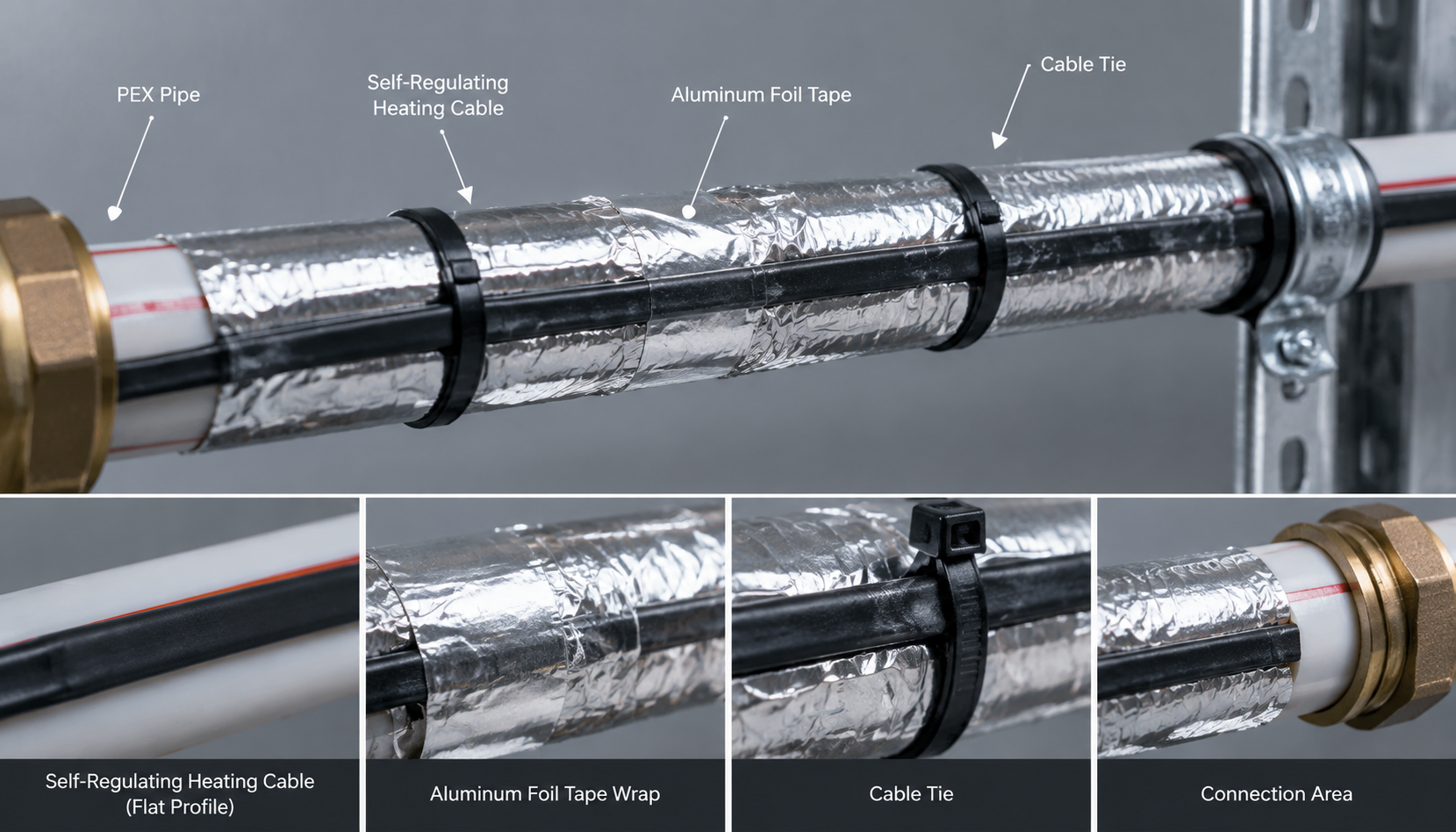
Applying aluminum foil tape represents the single most critical installation requirement when heat tracing plastic plumbing lines. Because PEX exhibits poor thermal conductivity, the heating cable only warms the narrow line of direct physical contact. Aluminum tape functions as a conductive radial heat spreader, which distributes thermal energy around the entire outer circumference. According to international standards documented in IEC electric trace heating publications, metallic foil dramatically improves thermal coupling on non-metallic surfaces. Consequently, using aluminum tape eliminates hazardous temperature differentials while delivering consistent freeze protection throughout the fluid conduit.
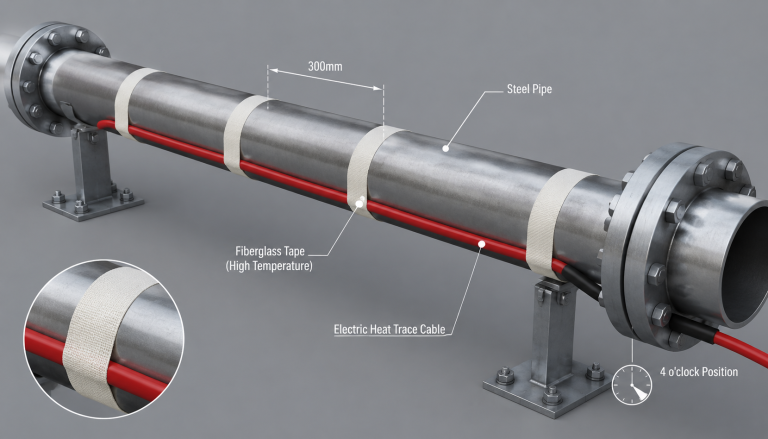
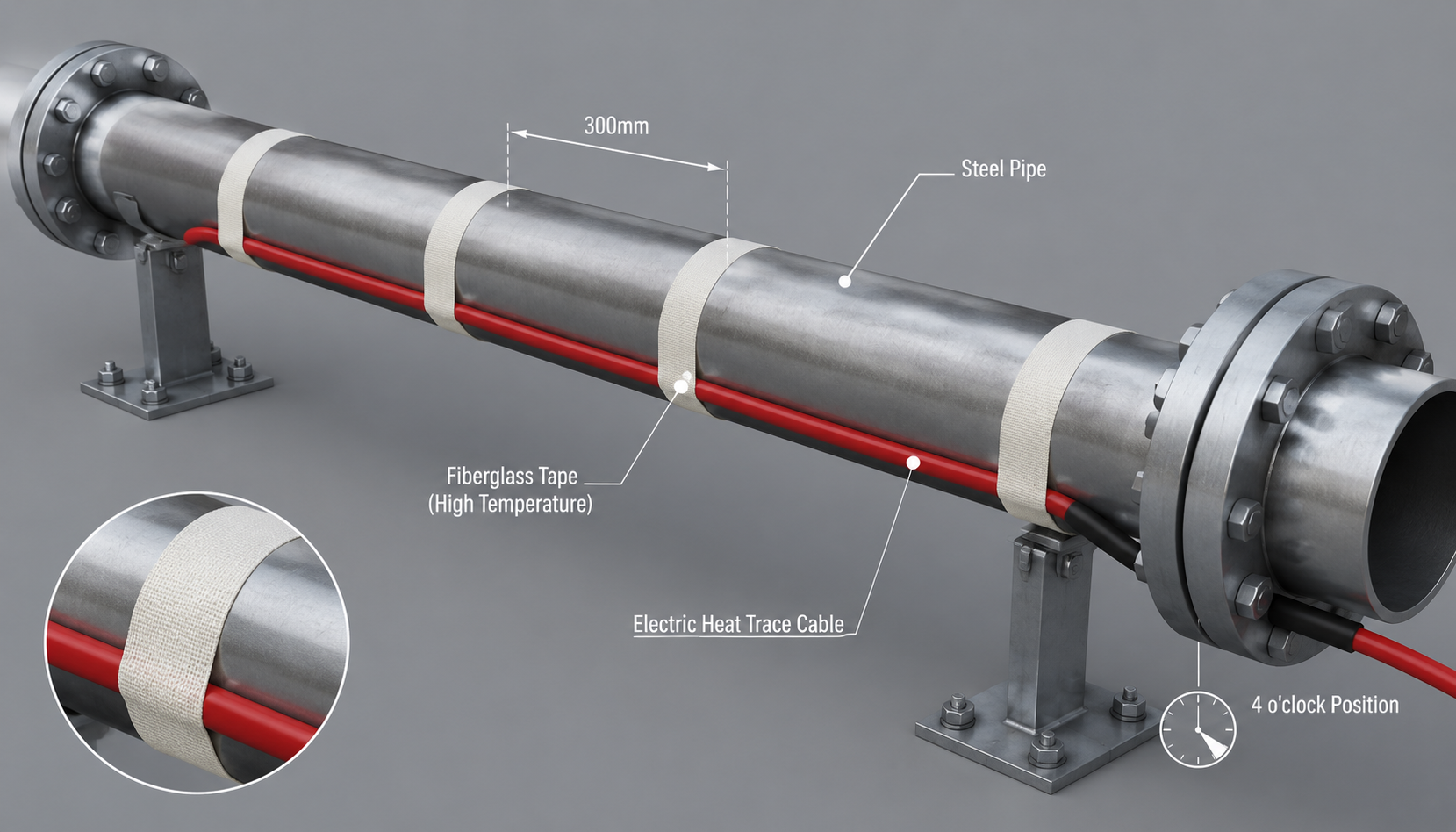
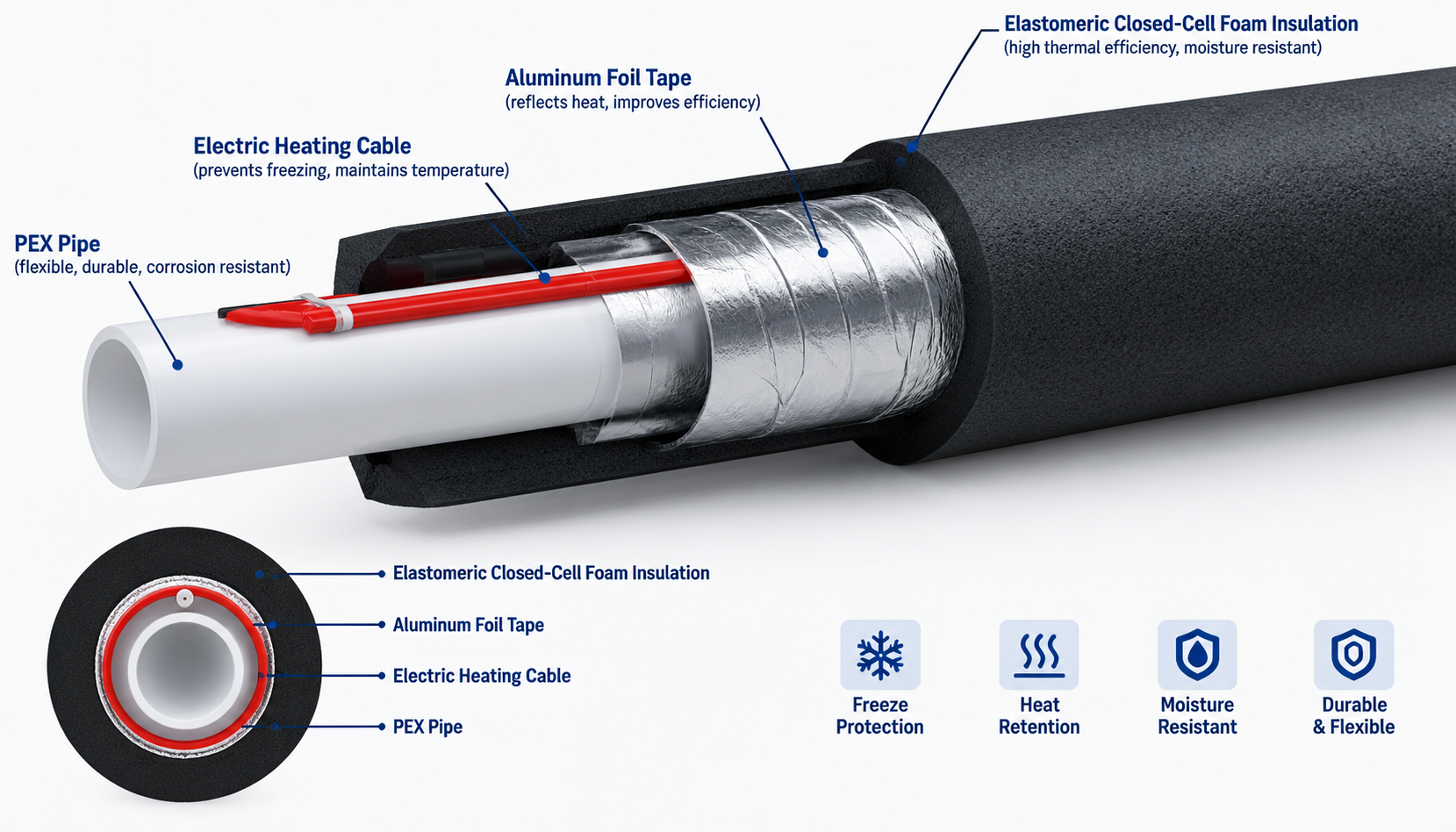
Contractors must execute a specific two-step taping technique to maximize thermal efficiency on non-metallic piping runs. Installers first apply continuous aluminum tape directly along the pipe where the heating cable will rest. Next, technicians secure the self-regulating cable directly over this initial aluminum layer using high-temperature fiberglass tape. Finally, workers apply a second layer of aluminum foil tape longitudinally over the entire cable assembly. This sandwich configuration ensures continuous thermal contact, which reflects radiant heat back toward the fluid-filled pipe core.
Using standard vinyl electrical tape or plastic zip ties instead of aluminum foil tape causes severe system failures. Plastic zip ties pinch the heating cable against the pipe, which creates localized mechanical stress and point-load overheating. Furthermore, vinyl adhesives break down rapidly under sustained operating temperatures, leaving the heating cable hanging loosely below pipes. Loose cables create dead air gaps, which act as thermal insulators and prevent heat from entering pipes. In contrast, heavy-duty aluminum tape provides robust mechanical support while optimizing thermal conductivity across the polymer pipe.
Thermostat Placement and Overheat Safeguards
Precision temperature controls and overheat safeguards are vital for maintaining energy efficiency and structural pipe integrity. Standard PEX tubing maintains a maximum continuous operating limit of 82 degrees Celsius at standard residential pressures. Operating electric trace heating without an automated thermostat wastes significant electrical power during warmer daytime operating hours. Furthermore, unmonitored heating cables inside unventilated building cavities can elevate ambient temperatures to uncomfortable or unsafe levels. Installing mechanical ambient thermostats or electronic pipe-sensing controllers prevents redundant heating and protects downstream plumbing fixtures.
Technicians must position the pipe temperature sensor on the opposite side of the pipe from the heating cable. Placing the sensor 180 degrees away ensures that the probe measures internal fluid temperature rather than direct cable heat. If the thermostat sensor touches the heating cable directly, the controller will cycle off prematurely before water warms. Conversely, placing the sensor too far away along uninsulated sections results in continuous heating and thermal waste. Secure the sensor bulb firmly to the bare pipe wall using aluminum tape before applying external insulation.
Electrical safety codes require ground-fault equipment protection (GFEP) on every circuit serving electric pipe heat tracing systems. Standard domestic GFCI breakers trip at 5 milliamperes, which often causes nuisance tripping on long heating circuits. Therefore, engineers specify 30-milliampere ground-fault equipment protection devices designed specifically to accommodate natural trace heating capacitive leakage. This specialized protection instantly isolates the electrical power supply if physical damage punctures the cable jacket. Implementing comprehensive electrical safeguards protects property structures while ensuring reliable cold-weather freeze prevention year after year.
Step-by-Step PEX Pipe Heat Tracing Installation Checklist
Professional contractors must execute heat tracing installations with disciplined precision to prevent costly plumbing failures during winter freezes. Rushing the installation process or skipping verification steps often results in damaged piping or complete freeze protection breakdowns. Following a standardized engineering checklist ensures that every component meets rigorous electrical and thermal performance standards. Review the following step-by-step procedures before mounting heating cables onto cross-linked polyethylene distribution piping in any facility.
- Inspect PEX tubing thoroughly for pre-existing scratches, sharp burrs, or physical kinks before attaching any heating components.
- Conduct a 1000-volt DC Megger insulation resistance test on the heating cable to confirm core electrical integrity.
- Clean the exterior pipe surface completely to remove dust, oil, and construction debris prior to tape application.
- Apply a continuous baseline layer of heavy-duty aluminum foil tape directly along the designated cable positioning path.
- Fasten the self-regulating cable straight along the bottom half of horizontal PEX pipes using heat-resistant fiberglass tape.
- Cover the entire heating cable run with a second layer of aluminum tape to ensure complete circumferential heat spreading.
- Mount the thermostat temperature sensing bulb 180 degrees opposite the heating cable directly on bare pipe surface.
- Install pre-formed closed-cell elastomeric foam pipe insulation over the traced pipe, sealing all seams with waterproof vapor-barrier tape.
- Perform a secondary Megger test and complete circuit breaker continuity checks before energizing the freeze protection system.
Adhering strictly to this engineering checklist ensures durable freeze protection while maintaining compliance with relevant plumbing codes. Contractors must never skip the post-installation insulation resistance test, because hidden screw punctures can cause electrical grounding faults. In addition, high-quality closed-cell insulation prevents moisture ingress from degrading heating efficiency across freezing outdoor ambient temperatures. Plumbers should place durable trace heating warning labels every ten feet along the outer insulation jacket. Documenting electrical resistance readings inside the electrical distribution panel provides clear proof of professional commissioning for facility managers.
Product Selection Guidance for Commercial PEX Heat Tracing
Selecting the correct heating cable output requires calculating total pipe heat loss under worst-case local winter temperatures. For most standard residential and commercial PEX water lines, cables rated at 3 to 5 watts per foot suffice. Installing cables with power outputs exceeding 6 watts per foot creates unnecessary thermal stress on thin-walled plastic piping. Furthermore, commercial buyers should select fluoropolymer outer jackets when installing heat trace cables in harsh chemical environments. For general commercial building services, rugged polyolefin outer jackets deliver exceptional abrasion resistance and reliable moisture protection.
| Pipe Diameter (NPS) | Cable Rating (@ 10°C) | Jacket Material | Aluminum Coverage | Insulation Thickness | Thermostat Sensor |
|---|---|---|---|---|---|
| 1/2″ to 3/4″ PEX | 3 W/ft (10 W/m) | Modified Polyolefin | Double Layer Sandwich | 1/2″ (13mm) Elastomeric | Ambient Air Controller |
| 1″ to 1-1/4″ PEX | 5 W/ft (16 W/m) | Modified Polyolefin | Double Layer Sandwich | 3/4″ (19mm) Elastomeric | Line-Sensing RTD Sensor |
| 1-1/2″ to 2″ PEX | 5 W/ft (16 W/m) | Fluoropolymer | Double Layer Sandwich | 1″ (25mm) Elastomeric | Line-Sensing RTD Sensor |
| Commercial Risers | 6 W/ft (20 W/m) Max | Fluoropolymer | Double Layer Sandwich | 1-1/2″ (38mm) Elastomeric | Proportional Digital Controller |
Plumbing engineers must also verify that operating voltages match available facility electrical supplies before ordering commercial heat tracing. While residential projects generally operate on 120-volt circuits, large commercial distribution networks frequently benefit from 208-volt or 240-volt supplies. Higher voltage distribution circuits allow longer single-circuit circuit lengths, which significantly reduces the total number of required power connection boxes. Moreover, purchasing pre-terminated heating cable kits simplifies field assembly and eliminates the need for complex on-site electrical terminations. Partnering with an experienced heat tracing manufacturer ensures that custom cable assemblies arrive fully certified and ready for immediate deployment.
Frequently Asked Questions About Heat Tape on PEX
Can you put heat tape on PEX tubing without aluminum foil?
Installing heat tape on PEX tubing without aluminum foil tape violates standard engineering practices and manufacturer warranties. Because cross-linked polyethylene is a poor thermal conductor, heat remains localized directly along the narrow cable contact strip. This localized concentration of thermal energy leaves the opposing pipe wall completely unprotected against freezing winter ambient temperatures. Applying continuous aluminum foil tape distributes heat around the entire pipe circumference, ensuring dependable and uniform freeze prevention.
Will self-regulating heating cable melt or damage PEX pipe?
Certified self-regulating heating cables will not melt or damage PEX pipe when installed with proper thermal controls. The conductive polymer core in self-regulating cables naturally throttles power output as pipe surface temperatures increase toward equilibrium. Even during prolonged continuous operation, standard freeze-protection cables maintain surface temperatures well below the safe thermal limits of PEX. However, contractors must never use constant-wattage heating tape, which can easily overheat and deform plastic piping systems.
Can heat tape be overlapped when installed on PEX piping?
Only self-regulating heating cables can safely overlap on PEX piping without creating dangerous high-temperature hazard zones. Self-regulating cables automatically diminish heat output at the exact overlap point to prevent dangerous thermal accumulation from developing. In contrast, overlapping constant-wattage heating tape generates intense concentrated heat that rapidly melts plastic pipes and ignites insulation. Always confirm that heating cable labels explicitly certify self-regulating technology before creating overlapping wraps around valves and elbows.
What is the maximum wattage rating recommended for PEX pipe freeze protection?
Mechanical engineers recommend a maximum heat output between 3 and 5 watts per foot for PEX freeze protection. Heating cables delivering up to 5 watts per foot provide sufficient thermal energy for sub-zero conditions without overheating plastic. Cables exceeding 6 watts per foot generate excessive thermal energy that can degrade cross-linked polyethylene over long periods. Always calculate specific heat loss based on pipe diameter, ambient temperatures, and insulation thickness before choosing cable wattage.
Do electrical codes require dedicated circuits for PEX pipe heat tracing?
National electrical codes mandate dedicated branch circuits equipped with ground-fault equipment protection for permanent pipe trace heating installations. Sharing electrical circuits with lighting fixtures or household convenience outlets increases the risk of nuisance circuit breaker overloads. A tripped circuit breaker de-energizes the heating cable unnoticed, which leads to catastrophic pipe freezing during severe cold snaps. Dedicated circuits equipped with 30-milliampere ground-fault breakers guarantee continuous, uncompromised power delivery throughout harsh winter months.
Reliable B2B Trace Heating Solutions from Youfu Thermal
Selecting the appropriate trace heating equipment ensures peace of mind, system longevity, and total code compliance for commercial projects. Youfu Thermal manufactures premium-grade self-regulating heating cables, control thermostats, and specialized installation accessories for industrial and commercial applications. Our engineering team provides custom thermal calculations, comprehensive product selection guidance, and direct technical support for mechanical contractors. Whether you are outfitting large commercial plumbing risers or residential freeze protection systems, we deliver certified high-performance solutions. Contact Youfu Thermal today to request detailed product specifications, competitive bulk pricing, or engineering project consultations.